Get the world’s most fascinating discoveries delivered straight to your inbox.
You are now subscribed
Your newsletter sign-up was successful
Want to add more newsletters?
Join the club
Get full access to premium articles, exclusive features and a growing list of member rewards.
An account already exists for this email address, please log in.
Australia's 'upside down' dinosaur age had two giant predators, 120 million-year-old fossils reveal
A new study has revealed that "hug of death" megaraptorids and previously unknown carcharodontosaurs shared Australia's unique Antarctic dinosaur ecosystem during the Cretaceous.
Researchers in Australia have discovered fossils of two enormous predators that lived alongside one another, upending ideas about how the ancient ecosystem operated down under 120 million years ago. This cache of fossils included the oldest large megaraptor ever found.
Megaraptorids were a group of fearsome predators in the Cretaceous period (145 million to 66 million years ago). They lived in the ecosystems of Australia and South America, which were joined together via Antarctica as part of a massive southern landmass called Gondwana.
Study lead-author Jake Kotevski, a paleontology doctoral candidate at the Museums Victoria Research Institute and Monash University in Australia, described megaraptorids as a "hands first predator" with muscular forearms and long, curved claws for catching prey — they effectively bring their prey in for a "hug of death," he said in a video released by Museums Victoria.
The fossils discovered by Kotevski and his colleagues belonged to an unspecified 120 million-year-old megaraptorid that was 20 to 23 feet (6 to 7 meters) long — making it one of the largest theropods (a bipedal group of mostly meat-eating dinosaurs) ever discovered in Australia. It also predates megaraptorids in South America by around 30 million years.
In the new study, published Feb. 19 in the Journal of Vertebrate Paleontology, researchers also identified fossils from another group of large, predatory dinosaurs called Carcharodontosauria, which are also found in South America but have never been identified in Australia before.
The carcharodontosaur fossils suggest that in Australia, these dinosaurs grew up to 13 feet (4 m) long, which is significantly shorter than their counterparts in South America, which grew up to 43 feet (13 m).
In other words, the roles of the two predatory dinosaurs seem to have been reversed in Victoria, with megaraptorids acting as the larger apex predators and carcharodontosaurs acting as smaller, secondary predators. Australia's unique Cretaceous ecosystem therefore had an "upside-down" dynamic, according to a statement released by Museums Victoria.
Sign up for the Live Science daily newsletter now
Get the world’s most fascinating discoveries delivered straight to your inbox.
The newly identified fossils were found in what were the banks of a large river, like the modern-day Ganges or Amazon, Kotevski told Live Science in an email. Southern Australia was close enough to the South Pole that it was within the Antarctic Circle during the Cretaceous, although the region was much warmer then than it is today.
The team identified the fossils, collected from the upper Strzelecki rock formation on the coastline of Victoria in southern Australia between 1988 and 2022, with modern 3D imaging techniques, including micro-computed tomography. The technique involves taking X-rays of an object as it rotates 360 degrees so that it can be studied in greater detail.
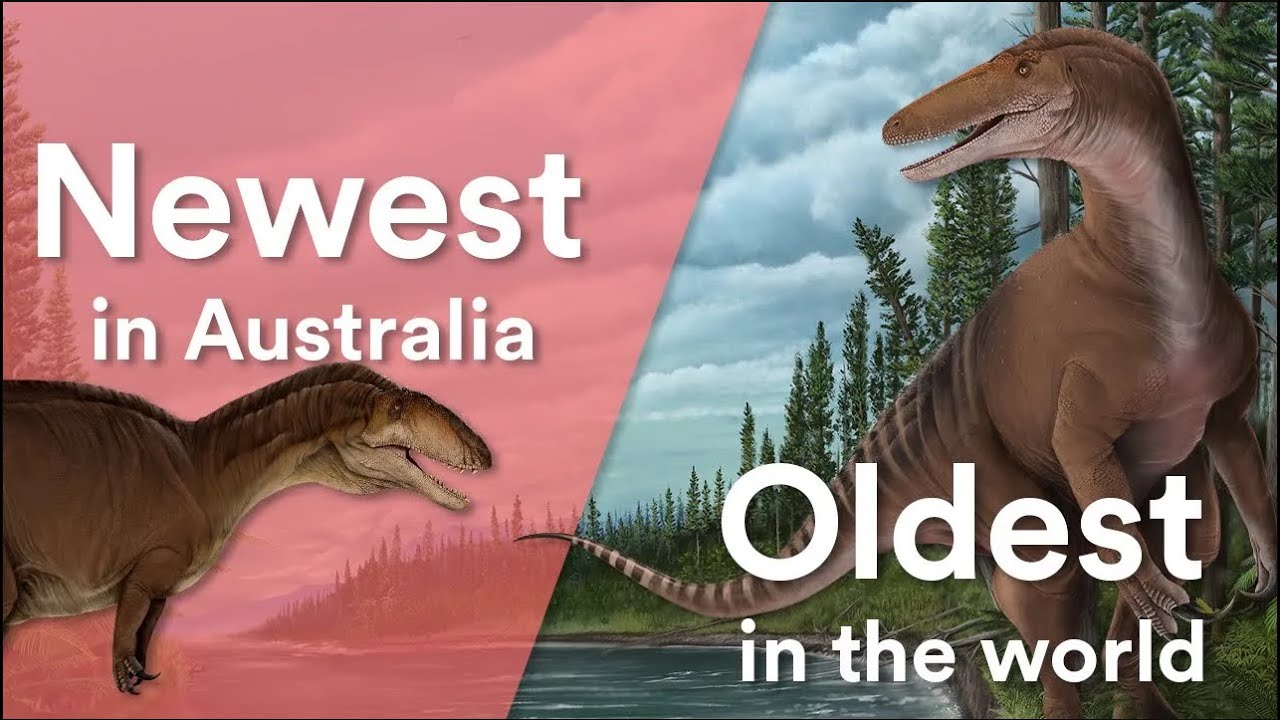
"Hug of death" megaraptorids were southern Australia's apex predators during the Cretaceous period.
(Image credit: Artwork by Jonathan Metzger. Source: Museums Victoria)
The fossils revealed that giant megaraptorids and carcharodontosaurs were living near the river, which Kotevski said was situated within a vast rift valley created as Australia pulled away from Tasmania and Antarctica.
"In the Antarctic circle, it has been proposed that Cretaceous [Victoria] experienced long periods of dark/light that the poles experience today," Kotevski said. "Thick forests lined this fast flowing river, where [a] myriad [of] small dinosaurs thrived, seemingly dominated by our … apex predator megaraptorid."
The discoveries add to evidence that dinosaurs were traveling across Antarctica to move between South America and Australia during the middle of the Cretaceous, according to the study. However, Kotevski noted that researchers still have a lot more to learn about the Australian dinosaur ecosystem.
"More discovery, collection and research is fundamental to further unlocking these secrets and building a picture of how these animals looked, differed, and behaved within their environment," Kotevski said.
Patrick Pester is the trending news writer at Live Science. His work has appeared on other science websites, such as BBC Science Focus and Scientific American. Patrick retrained as a journalist after spending his early career working in zoos and wildlife conservation. He was awarded the Master's Excellence Scholarship to study at Cardiff University where he completed a master's degree in international journalism. He also has a second master's degree in biodiversity, evolution and conservation in action from Middlesex University London. When he isn't writing news, Patrick investigates the sale of human remains.
You must confirm your public display name before commenting
Please logout and then login again, you will then be prompted to enter your display name.